
Appearance
Y901 Multi-Point Wireless Alarm Specification
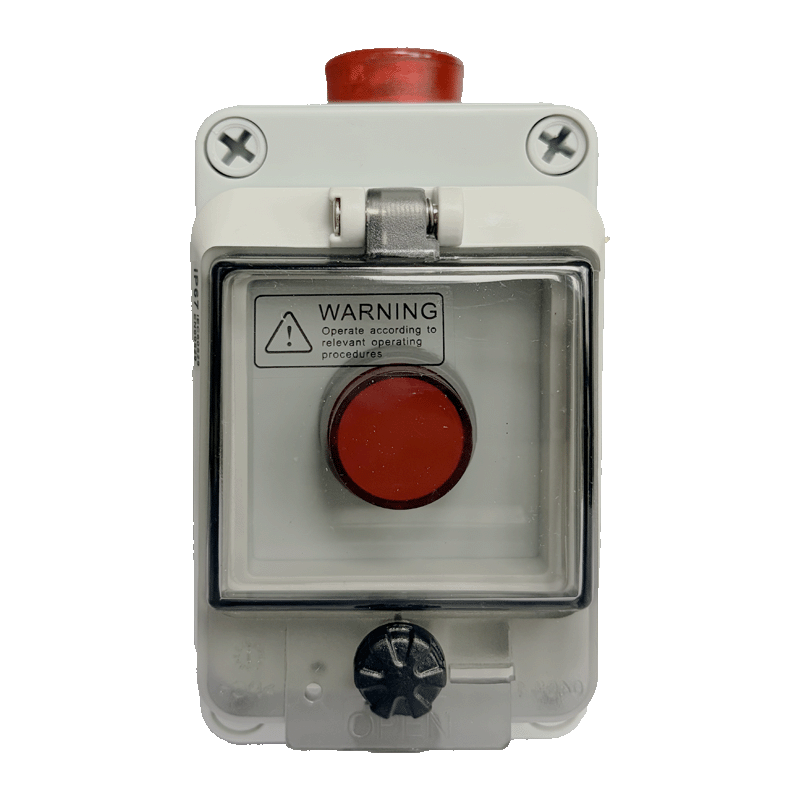
Contents
- Overview
- Ordering Information
- Key Features
- Technical Specifications
- Interfaces and Indicators
- Important Notes
1. Overview
The Y901 is a multi-point wireless mesh alarm that integrates a latching switch and an audible/visual alarm. With IP67 protection, it enables rapid on-site alerting with "one-touch triggering, local alarm, and network-wide linkage." It is available with 4G or LoRa communication, corresponding to the Y901-G and Y901-L models.
The system supports a multi-node self-organizing wireless network. When the latching switch on any node is triggered, or when an external alarm contact closes, the local audible/visual alarm is activated immediately and the alarm status is synchronized to the other nodes. Once the signal is received, the other nodes also activate their audible/visual alarms. If one node is triggered, all nodes enter the alarm state. The network-wide alarm is cleared only after all trigger sources have been reset.
Trigger Methods
The Y901 supports multiple trigger methods to meet different alerting requirements:
| Method | Description |
|---|---|
| Manual Button (Default) | Built-in latching button maintains the trigger state after being pressed; suitable for on-site emergency assistance or incident reporting |
| Sensor Input | Supports external sensors such as door contacts, float switches, and PIR sensors; alarm is triggered through a dry contact input |
| Remote Command | Supports alarm triggering by remote command from a monitoring center |
| Custom | Additional trigger methods can be customized on request |
Network Topology

The Y901 employs a multi-point wireless architecture with automatic relay networking, extending alarm coverage across multiple nodes without complex wiring.
Operating Principle
- When the latching switch on any node closes, that node enters the alarm state immediately
- The alarm status is synchronized to the other nodes through the wireless network
- After receiving the alarm signal, the other nodes also activate their local audible/visual alarms, so all nodes alarm simultaneously
- The nodes support automatic relay networking, and the system automatically searches for better communication paths to extend coverage
- The network-wide alarm stops only after all trigger conditions have been cleared
Application Scenarios
- Emergency alerting in long-distance areas such as tunnels, underpasses, and utility corridors
- Distributed linkage alarm applications for factory production lines, equipment rooms, and pump stations
- Assistance and warning applications in construction sites, inspection routes, and hazardous areas
- Multi-point wireless interlocked alarm applications where wiring is impractical
- Alerting scenarios in humid, dusty, or outdoor environments where waterproof protection is required
2. Ordering Information
2.1 Model Naming
Y901-C
   │  └── C: Communication (G / L)
   └───── Y901: Wireless intelligent mesh alarm series
2.2 Communication Suffix
| Suffix | Communication | Application |
|---|---|---|
-G | 4G | Suitable for cross-region alarm networking applications that depend on platform connectivity |
-L | LoRa | Suitable for on-site multi-node wireless linkage and automatic relay applications |
2.3 Package Contents
| Quantity | Item |
|---|---|
| 1 | Y901 Multi-Point Wireless Mesh Alarm |
| 1 | Antenna |
| 1 | DC Power Adapter |
3. Key Features
- Integrated alarm terminal — Integrates a latching switch, wireless mesh linkage control, and audible/visual alarm output
- Any-point trigger, network-wide linkage — When any node is triggered, all nodes immediately activate synchronized audible/visual alarms
- Automatic relay networking — Nodes automatically search for optimal links and form a relay network; maximum distance between two nodes is 5 km in open areas, with a 10 km option available; suitable for long corridors and obstructed environments
- Multiple trigger methods — Supports manual button triggering (default latching button), sensor triggering, remote command triggering, or customized triggering methods
- Latching alarm retention — The latching switch maintains trigger state after activation, suitable for sustained on-site assistance and fault indication
- Wide voltage supply — Supports
9-36 VDCpower input for easier on-site power planning - IP67 protection — Suitable for outdoor, humid, and dusty environments
- Multiple communication options — Available with
4GorLoRawireless communication - Clear and noticeable alarm — Built-in
95 dBbuzzer with intermittent beeping and a flashing red indicator - Industrial-grade design — Suitable for complex industrial sites and building facility alarm applications
4. Technical Specifications
4.1 Communication Parameters
| Parameter | Specification |
|---|---|
| Communication | 4G / LoRa |
| Model suffix | -G / -L |
| Network architecture | Multi-node wireless mesh linkage |
| Coverage expansion | Supports wireless network expansion with automatic relay |
| Relay range | Maximum distance between two nodes is 5 km in open areas; 10 km option available |
| Communication accessories | Configured according to the communication variant |
4.2 Electrical and Control Parameters
| Parameter | Specification |
|---|---|
| Supply voltage | 9-36 VDC |
| Trigger methods | Manual button (default latching button) / Sensor input / Remote command / Custom |
| Input type | Passive dry contact input |
| Alarm type | Audible/visual buzzer alarm |
| Sound level | 95 dB |
| Light pattern | Flashing red LED |
| Sound pattern | Intermittent beeping |
| Linkage logic | When any node is triggered, all nodes alarm simultaneously |
| Reset logic | The network-wide alarm stops only after all trigger sources are cleared |
| Power consumption | Per communication variant |
4.3 Environmental Parameters
| Parameter | Specification |
|---|---|
| Operating temperature | -20°C to +85°C |
| Operating humidity | 10-90% RH (non-condensing) |
4.4 Mechanical Parameters
| Parameter | Specification |
|---|---|
| Product form | Integrated terminal with latching trigger, wireless linkage, and audible/visual alarm |
| Construction | Wireless linkage control unit, trigger mechanism, and audible/visual alarm mechanism |
| Mounting | Confirmed according to the structural variant |
| Dimensions | Confirmed according to the structural variant |
| Protection rating | IP67 |
Note: Dimensions and mounting method are subject to the actual configured product variant.
5. Interfaces and Indicators
5.1 Interface Overview
| Interface | Description |
|---|---|
| Antenna | Wireless communication antenna, configured according to the product variant |
| Power input | DC 9-36V input; a stable DC power supply is recommended |
| Latching switch | Manual on-site alarm trigger; remains latched after being pressed |
| Audible/visual alarm | Local 95 dB intermittent buzzer with flashing red LED; responds to the wireless linkage status |
6. Important Notes
- Linkage retention logic — As long as any node remains in the triggered state, the network-wide alarm remains active; one triggered node causes all nodes to alarm
- Communication variants —
-Gindicates4G, and-LindicatesLoRa - Antenna installation — The wireless antenna should be kept away from enclosed metal cabinets to avoid affecting wireless performance
- Field reset — After the latching switch is triggered, it must be reset manually before the system can exit the alarm state
- Networking method — The device supports wireless mesh linkage and can extend multi-node alarm coverage without complex wiring
- Protection capability — The unit is rated
IP67, but prolonged immersion and abnormal pressure should still be avoided during installation - Product parameters — Structural details, mounting method, and configuration details are subject to the actual shipped version
- Manufacturer: Hunan YenGear Tech Co., Ltd.
- Address: Room 21014, Building 1, Fudi Xingguang Tiandi, Yingxin Road, Yuhua District, Changsha, Hunan, China
- Email: [email protected]
- Website: www.yengear.com